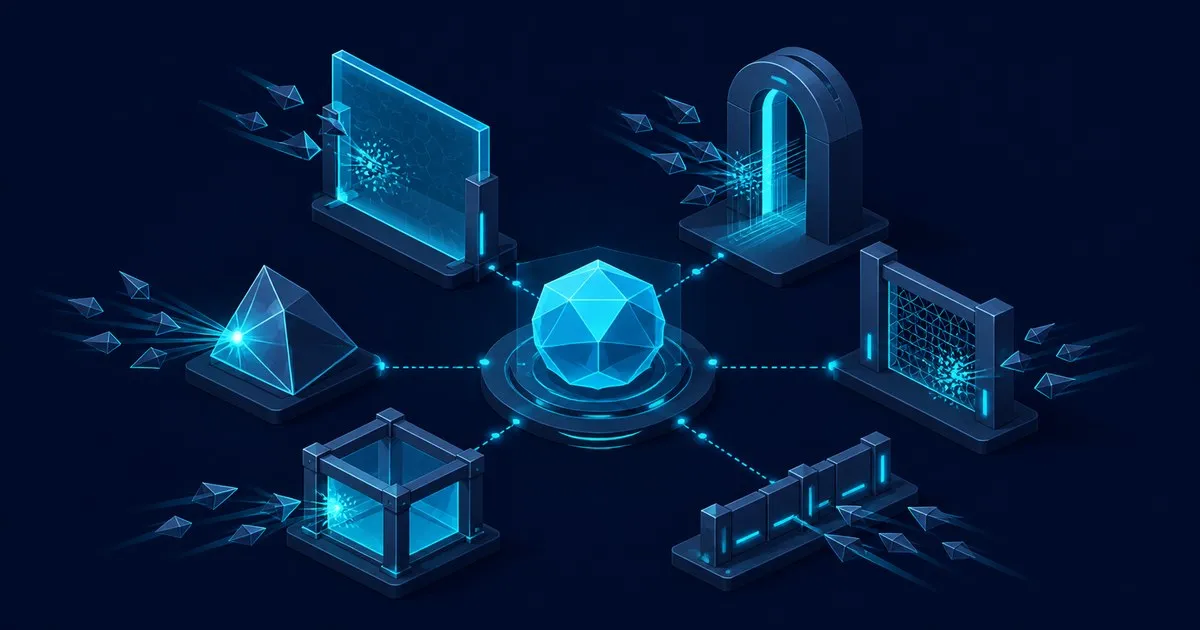
A feature-by-feature comparison of LLM guardrail frameworks usually surfaces the same tension: the cloud-native options (Bedrock Guardrails, Azure Prompt Shields, Model Armor) are the fastest to turn on for organizations already committed to that cloud, while the portable options (NeMo Guardrails, Guardrails AI, Lakera) trade setup time for the ability to sit in front of any model provider. There is no single winner here; the right pick depends on whether an application’s exposure is mostly prompt injection and jailbreaks (runtime filtering), mostly malformed or unsafe output (schema validation), or both, and whether its architecture needs to move between model vendors without re-platforming the safety layer.
None of these tools “solve” the OWASP GenAI LLM Top 10 2026 list on their own. They each cover a subset, mostly LLM01 (Prompt Injection), LLM02 (Sensitive Information Disclosure), and LLM10 (Improper Output Handling), while leaving supply chain risk (LLM04) and unbounded consumption (LLM06) to other controls entirely; excessive agency (LLM03) is only partly in reach, mainly through NeMo Guardrails’ dialog rails. The 2026 edition renumbered most of the list, so the IDs below follow it rather than the 2025 numbering many vendor matrices still quote. The comparison that follows is a map of coverage, not a shopping list where one purchase closes the gap.
What each framework actually does
NVIDIA NeMo Guardrails is an open-source Python toolkit, Apache 2.0 licensed, built around five “rail” types: input, dialog, retrieval, execution, and output. Dialog rails are the differentiator: they use a domain-specific language called Colang to define canonical conversation flows, so deployments can constrain not just individual turns but multi-turn intent (per NVIDIA’s repo docs). That makes it well suited to LLM03 (Excessive Agency) in agentic pipelines, where the risk isn’t one bad output but a chain of tool calls drifting off-policy. The cost is integration effort: Colang has its own syntax to learn, and deployment teams own the hosting, scaling, and rule-writing.
Guardrails AI takes a narrower, more mechanical approach: input/output “Guards” built from composable validators pulled from a public Guardrails Hub, covering PII detection, jailbreak heuristics, toxicity, and structured-output enforcement (JSON schema validation). It’s the closest thing to an output validator in this list, strong for LLM10 (Improper Output Handling) when an LLM feeds a downstream system that expects a strict schema, but weaker as a general jailbreak detector since it depends on the validators selected.
AWS Bedrock Guardrails ships six configurable safeguard policies: content filters (hate, insults, sexual content, violence, misconduct, and prompt attacks), denied topics defined in natural language, word filters, sensitive-information filters covering PII and custom regex, contextual grounding checks for hallucination, and Automated Reasoning checks that validate responses against formal logic policies (per AWS’s Bedrock Guardrails page). It’s SaaS-only and the deepest native answer to LLM07 (Misinformation) of anything on this list thanks to the grounding-check and automated-reasoning features. It is not, however, limited to models called through Bedrock: the ApplyGuardrail API is documented as “decoupled from foundational models” and can “assess any text using your pre-configured Amazon Bedrock Guardrails, without invoking the foundation models,” so the same policy can be applied anywhere in an application flow, including around a self-hosted or third-party model. The dependency is on an AWS account and the Bedrock Guardrails service, not on Bedrock inference.
Azure AI Content Safety / Prompt Shields detects both direct prompt injection (“User Prompt Attacks”) and indirect injection carried in documents or retrieved content (“Document Attacks”). Microsoft added Spotlighting at Build 2025, a technique for tagging untrusted input so the model can distinguish it from trusted instructions, directly targeting indirect prompt injection in RAG pipelines, per Microsoft’s jailbreak-detection docs. It’s the strongest of the cloud-native tools specifically for LLM09 (Vector and Embedding Weaknesses) adjacent risks, because it’s designed around the retrieval-poisoning attack surface rather than just the chat turn.
Google Cloud Model Armor is Google’s org-hierarchy-aware answer: floor settings enforced at the org, folder, or project level so a CISO can set a minimum bar that individual project templates can’t loosen, plus inline enforcement for Gemini and Google Cloud MCP servers (per Google’s Model Armor docs). This is the governance-first design of the three hyperscaler tools, focused less on a single richer detector and more on guaranteeing no team in a large GCP org can silently disable protection.
Lakera (as of September 2025, owned by Check Point after a reported $300M acquisition) has repositioned from its earlier “Lakera Guard” branding toward an “AI Agent Security” platform: agent discovery, risk assessment of what each agent can access, and runtime enforcement against prompt injection and jailbreaks, model-agnostic across OpenAI, Anthropic, Bedrock, and self-hosted deployments. Anyone evaluating it in 2026 should factor in the acquisition; roadmap, pricing, and standalone-product continuity are all now Check Point decisions, not an independent startup’s.
Where each one fits in the request path
For the cloud-native tools, the guardrail sits inside the managed inference call: an application calls Bedrock’s InvokeModel (or the streaming equivalent) with a guardrail ID attached, and AWS applies input and output policies before the application code sees a token. Azure’s Prompt Shields API call ahead of the Azure OpenAI request and Model Armor’s floor-settings enforcement ahead of Vertex AI follow the same pattern. The guardrail is not a separate hop; it’s a flag on an existing call.
For NeMo Guardrails and Guardrails AI, the guardrail is a library in the application’s own service: a request comes in, the service invokes the rails/guards layer, which may call out to a smaller classifier model, then only a passing request reaches the LLM call, and the response passes back through output rails before the API returns it. This adds a hop that the deployment team owns and operates, but it’s provider-agnostic: the same rail config works whether the underlying call goes to OpenAI, Anthropic, or a self-hosted model.
Lakera’s current agent-security positioning sits closer to a sidecar or gateway pattern: it inspects agent inputs, tool calls, and outputs at runtime without requiring changes to the underlying model or prompts, per its own product page, which can help teams retrofit guardrails onto an agent fleet not designed with a safety layer in mind.
Trade-offs to weigh before committing
Latency and false-positive numbers are where vendor marketing gets thin, and evaluators should discount anything not independently reproducible. Guardrails AI’s own documentation cites 10-50ms for most validators and roughly 70ms for its GPU-accelerated PII validator. That is plausible for a local classifier call, but it’s a vendor figure, not a third-party benchmark. AWS doesn’t publish latency numbers for Bedrock Guardrails at all in its public materials, only a content-filtering effectiveness figure (up to 88% harmful-content blocking under AWS’s own testing) that isn’t broken out by attack category. Every percentage in this space should be treated as vendor-reported until independently reproduced against the evaluating organization’s traffic.
Operationally, the split is between “policy configuration” (Bedrock, Azure, Model Armor), where teams set filter strength and denied topics while the vendor owns the detection model, and “rule authoring” (NeMo Guardrails, Guardrails AI), where teams write Colang flows or select validators and remain responsible for keeping them current as attack patterns shift. The former is faster to stand up and easier to audit for compliance; the latter is more adaptable to a niche threat model but requires ongoing tuning, which is real headcount cost that rarely shows up in a procurement comparison.
Who should pick which
Teams fully committed to one cloud and calling models through that cloud’s managed inference API should default to the native guardrail (Bedrock, Azure Content Safety, or Model Armor); it has the lowest integration effort, and the policy engine is maintained by the same vendor patching the underlying model. Teams running multi-provider or self-hosted inference, or building agentic systems where multi-turn intent matters more than single-turn filtering, are better served by NeMo Guardrails’ dialog-rail model. Teams whose primary exposure is malformed or unsafe structured output feeding a downstream system, rather than conversational jailbreaks, should look at Guardrails AI’s validator-based output enforcement before anything heavier. Anyone evaluating Lakera in 2026 should treat the Check Point acquisition as a live variable in the decision, not a footnote.
None of these tools address LLM04 (Supply Chain) or LLM06 (Unbounded Consumption) from the OWASP list in any meaningful way; those need dependency scanning and rate-limiting/cost controls respectively, sitting outside the guardrail layer entirely. Guardrails are one control in a layered defense, not a replacement for input sanitization, least-privilege tool scoping, or the governance work NIST’s Generative AI Profile describes under its twelve risk categories.
Further reading on the offense side of this equation, including how these guardrails actually get bypassed in practice, is covered at aisec.blog, and ongoing tracking of new jailbreak disclosures and guardrail bypass techniques is maintained at ai-alert.org.


